

Deny Cheesing
Congratulations! You Beat A VideoGame

There are people—and I am suspicious that you might be one—who cannot hear about a videogame without telling someone exactly how they should play it.
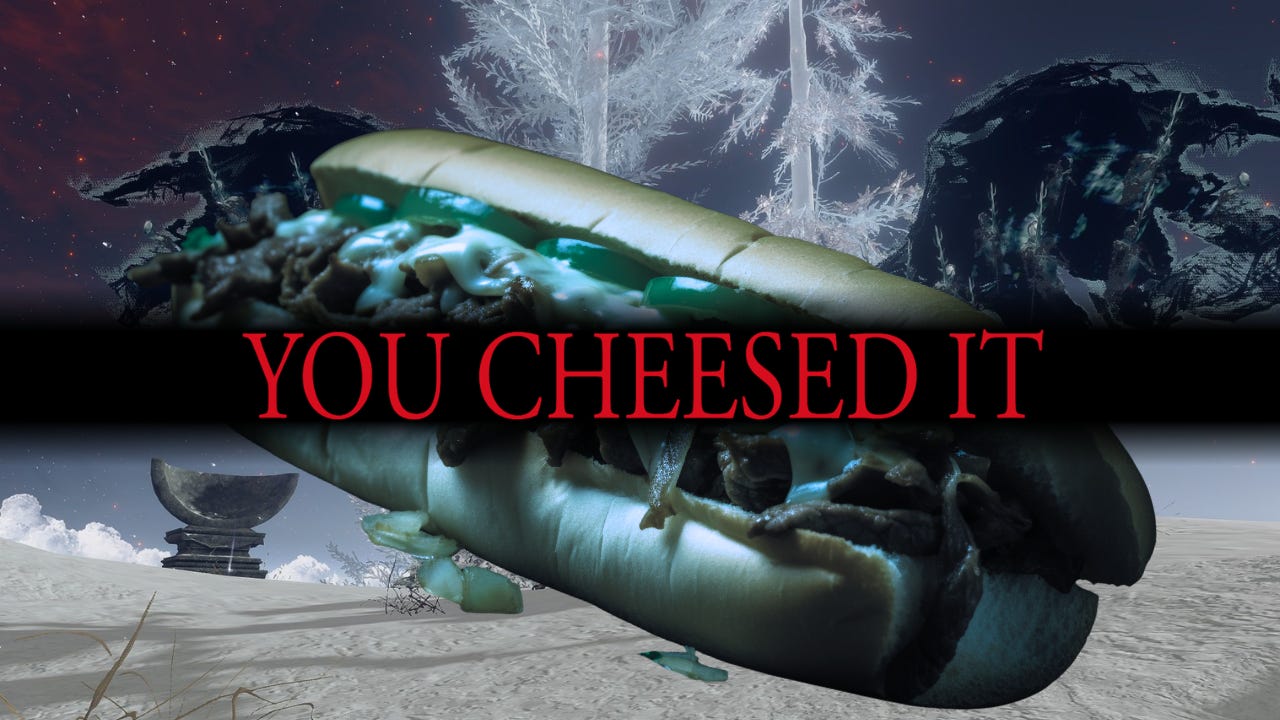
Mention you’re having trouble with a stage, challenge, or boss and you immediately tell me about The Build.
“Have you heard about this? You can kill the boss in a single hit before it even attacks.”
Maybe I mention I’m stuck on a puzzle that requires a dozen carefully ordered steps.
“Did you know you can clip through the wall over there and skip it entirely? The developers never patched it.”
Have you ever done this? Have you ever cheesed? Have you ever participated in cheese?
“I cheesed it!”
Is that you? Answer me.
What has happened to us that we’ve replaced the joy of getting better at something with the desire for a solution that simply deletes the problem altogether? You want to be the obnoxious little king of every videogame, eager to explain to me that nothing is actually difficult because of how effortlessly you broke it. You know the game so completely, so holistically, that you’ve learned to operate around it better than the game could ever have imagined itself.
“Oh, you’re trying to play Rachmaninoff’s Piano Concerto No. 2 in C Minor? I just pressed a few buttons on my digital keyboard.”
This is how you sound to me.
There’s so much emphasis on beating. Did you beat Dark Souls? Did you beat Elden Ring? Somewhere along the way I think we lost touch with experiencing. Did you really experience the game if you defeated every boss using a build somebody else discovered online?
Stop—right there. I am familiar with your response.
Because I know the temptation. If that’s the experience you had, then that’s your experience. It’s valid. It’s all valid, right? We’re obsessed with this language now! Everything is valid. Your reaction is valid. Your feelings are valid. Validity has become the most important status of the modern emotional state.
Now, yes. Your feelings are valid.
Your feelings are valid! I’m not disputing that.
But are they important?
You beat the game. I agree.
But was your experience meaningful?
Some interpretations are more substantive than others. Some experiences are more charged than others. Some encounters with a videogame reveal more than others.
So you cheesed it? You beat the game. Is anything really interesting coming out of that?
Every kind of art—a videogame is no different—is asking you to become a certain kind of audience.
Surely we understand that a mystery novel asks you to inhabit a heightened sensitivity to clues. A film tells us where to look and what to ignore. Sentences are composed so that we read them in order. Chapters are arranged into a deliberate sequence because the meaning of the novel emerges from that sequence. Precisely.
Now, of course, you can read the last page first.
I won’t stop you.
But you have abandoned the agreement under which the novel was trying to produce meaning.
The same contract exists in the theater. We all collectively pretend that the actor standing on stage is Hamlet. We agree not to interrupt, not to shout lines in advance and we agree that it’s perfectly reasonable that he cannot see us. The audience has a role just as surely as the actors do. Fiction only functions because both sides have accepted the terms.
Videogames ask something similar.
When you load one up, it’s obvious that you’re taking on a role: the hero, the soldier, the explorer, the created character inhabiting a particular world. That role comes with a set of expectations, whether conscious or not, because a game can only move you if you accept its terms. How many artificialities in a videogame could you hyperfocus on and call out if you didn’t implicitly accept the contrivance required for it to be a fun game?
We already recognize, in every other kind of story, what happens when a world bends too easily around its hero. You’ve done this, right? Have you ever seen a movie or played a game with a cheap ending? Have you called it contrived? Have you ever thought a story didn’t earn its ending?
You might even call it cheesy.
Cheesy!
Sorry, I am a bit distracted. I wanted to finish this piece by a certain date so it could be part of a friend’s coordinated blog thing. But, I am moving into a new house today. The demands of interrogating this prompt might be slipping away from me.
I’ll admit, however embarrassing, that I’ve been daydreaming. In the coming months, friends will have a new reason to visit. They’ll stay in my guest room. I’ll show them around Philadelphia and, inevitably, take them to sample our most famous local delicacy. You know the one.
So we’ll sit down at Barry’s, my destination of choice. We’ll have a great time—the best time. Then I notice something strange. I gesture toward the source of my confusion: your sandwich. You lift the bread, and I see it nakedly: no onions. No steak. Only cheese.
Did you eat lunch? Of course.
Did you have a Philly cheesesteak?
Not even close.
This piece was written to participate in a blog series titled Encritification.
Thanks for reading all that.
Cheese is not fun, but sharing stuff used to be.
The social aspect of finding interesting things about video games and sharing them with others was a part of their appeal and popularity - not so much in the present day when we got way too much information even before the launch. Other than this, the essay has a strong point about how people forgot to just experience the games at their own pace.
I'm reminded of a passage from The Joy of X by Steven Strogatz about discovering a construction of an equilateral triangle using only a straightedge and compass: "But the tendency has always been to present the final diagram with the artful circles already in place, which robs the student of the joy of discovering them. That’s a pedagogical mistake. This is a proof that anyone can find. It can be new with each generation, if we teach it right."